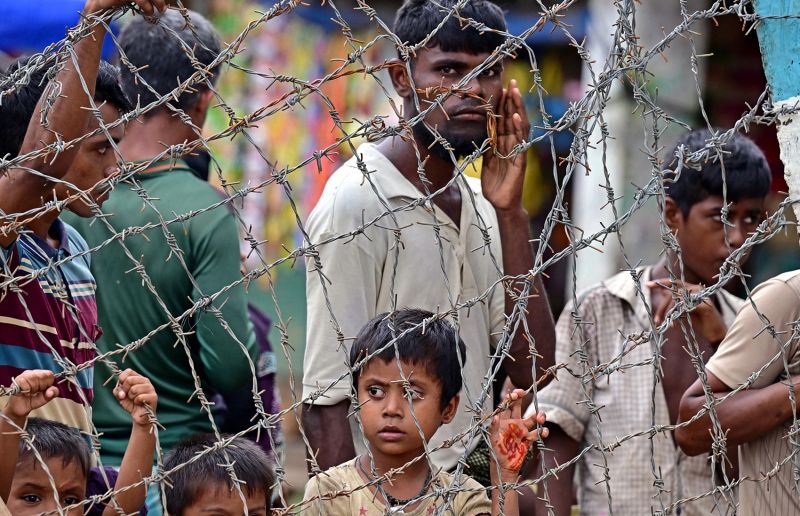
Photo by Ro Niyamot Ullah
WE WERE NOT BORN TO BE REFUGEES FOREVER
Mohammed Riaz,
Rohingya Human Rights Defender and Researcher and OMLAS Fellow 2025
For most people, home is a place they return to at the end of the day. It is where memories are made, families grow, and children dream about their future. For millions of my Rohingya brothers and sisters, however, home has become a memory that we carry in our hearts rather than a place we can touch. I write these words not only as a human rights defender but as someone who, since childhood, has lived through the realities of statelessness, hunger and fear.
From the day I was born in my homeland of Arakan, I have seen my people living through displacement, uncertainty and a constant struggle to belong. I grew up seeing my Rohingya families live without citizenship, without freedom of movement and without the security of knowing what tomorrow would bring. Over time, the word “refugee” became attached to our entire Rohingya generation. But we were not born to be refugees.
We were born into families, communities, villages, traditions and a homeland, just like others in this world. Being a refugee was a condition forced upon us. It’s not who we are. We have survived genocide, persecution and many years of exile. We have crossed mountains, rivers and borders to survive and find safety.
This is not simply a story of my life. It is the story of an entire Rohingya people—people whose voices have been spoken about but rarely heard. Our story has been discussed in government offices, humanitarian meetings, international conferences and courtrooms around the world. Yet we, whose lives are at the center of these discussions, are still left asking: “When will the decisions made about us begin to change our lives? When will REFUGEE life become life in our HOMELAND?”
Our memories of lost parents, children, siblings and homes live on. Memories of villages that no longer exist as they once did, live on. Memories remain of people who crossed the border carrying children while leaving behind everything they had built. We think of the children who were born after 2017 and inherited the consequences of what happened before they were even born. That is why describing the Rohingya crisis simply as a refugee crisis is incomplete. It is also a crisis of citizenship, accountability, identity and political rights.
I have participated in many meetings, workshops, consultations, conferences and discussions where people have spoken about the future of the Rohingya people. But we still ask the painful question: when will these discussions make meaningful changes in our lives? Every passing year another child grows up without quality education; another family struggles through monsoon rains; another generation must accept a life without a country to call its own. A decade may appear brief in terms of diplomatic negotiations, but for a child born in exile, it is an entire lifetime.
When people ask what we Rohingya want, my answer is simple. We do not want to remain refugees forever. We do not want our children to inherit a life in displacement. We do not want another generation to grow up believing that statelessness is normal. We would like what every family in the world wants: a safe home, equal rights, quality education, freedom of movement, meaningful work and the dignity of belonging to a country that recognizes us as their own.
Almost a decade in exile has changed the meaning of the word “temporary” for our people. What was supposed to be an emergency refuge has become the place where an entire generation is growing up. In Cox’s Bazar, we continue to live in fragile shelters made largely of bamboo and tarpaulin inside a mountain, each with limited space for several members of the same family. For many, the camp is the only environment children have ever known.
The consequences are particularly serious for children and young people. Education in the camps has continued through the work of humanitarian organizations and community-based initiatives. But the opportunities for preparing young people for a viable future remain limited. I have seen this reality closely as an educator and community worker. Rohingya young people want to become teachers, doctors, researchers, entrepreneurs, journalists and community leaders, like people everywhere.
Security is another serious concern. Our Rohingya communities and humanitarian actors have repeatedly raised concerns about kidnapping, extortion, trafficking, armed violence and other forms of insecurity inside and around the camps. These concerns are not abstract to me. Like many people working for and speaking about the Rohingya community, I have also had to think about personal safety while continuing my education, work and advocacy.
Being stateless takes away our dignity. Food aid can prevent hunger, but it cannot restore citizenship. Emergency shelters can protect families from rain, but they cannot replace permanent homes in a homeland. Medical treatment can heal physical injuries, but it cannot erase trauma or restore justice. We need lasting solutions addressing the root causes that forced us to flee in the first place.
I do not write these words to ask for sympathy. Sympathy matters but it cannot be the solution for a human rights struggle. What we need is:
- solidarity that leads to action,
- recognition of our humanity,
- meaningful participation in making decisions affecting our future,
- protection when we need safety,
- accountability for serious violations,
- sustained international engagement toward a genuine political solution.
Our Rohingya crisis reaches far beyond the borders of Bangladesh. Across South and Southeast Asia, displacement has caused many of our people to undertake perilous sea journeys, with hundreds drowning. Others fall victim to detention, trafficking and exploitation because they see no realistic path toward a secure future. These journeys show what prolonged statelessness and the absence of durable solutions can force people to do.
Malaysia became an important place of refuge for many, but Malaysia does not have a refugee protection framework. Refugees and asylum seekers have been poorly treated. For those held in detention, time becomes another form of suffering. Some Rohingya have spent years separated from spouses, children and other relatives while waiting to have their legal status resolved. It affects their mental well-being and their ability to build a meaningful life. Rohingya families in Malaysia live in constant fear of arrest or detention.
While hundreds of thousands of Rohingya live in exile, many others remain trapped inside Rakhine State. They live amidst a civil war that threatens their lives and fills them with fear. They live with restrictions on movement, access to humanitarian assistance, discrimination, and arbitrary detention. There are reports of forced recruitment—including women and children, arbitrary arrests, and other abuses.
Every Rohingya dreams of returning to their homeland. But a return cannot simply mean crossing the border back into Rakhine State. While the civil war rages, there is no safety. For us, return must mean the ability to live safely, move freely, and rebuild our homes. There must be access to education and healthcare and freedom to practice religion. We need opportunities to recover property where possible and live with recognized rights and legal protection. Without these conditions, we will only be going back to another cycle of insecurity.
Many have stood beside our community with compassion and genuine solidarity. Humanitarian workers, journalists, researchers, lawyers, activists, volunteers and ordinary citizens have helped keep our hope alive during our darkest moments. We remain sincerely grateful for their solidarity.
My perspective does not come from observing displacement from a distance. I have lived among the people whose future is being discussed. I have listened to families speak about lost relatives, interrupted education, insecurity, and the fear of what comes next. I have also seen the determination of Rohingya young people who continue to teach, organize, advocate and serve their communities despite having few opportunities to build their own future.
The Rohingya should not be thought of as victims. We are survivors. We know what we want for our future and never fail to work towards it. Our leaders are responsible individuals, but they need the political and civic space to play a meaningful part in solving the crisis that has shaped their lives.
Our demands are not extraordinary. We want the same basic rights that other people expect for themselves and their children: the right to live safely, to belong, to receive an education, to work with dignity, to move freely, to practice our religion and culture. We want the restoration of our citizenship and fundamental rights in Myanmar, together with effective protection against discrimination, persecution and future displacement.
I know that writing an article cannot bring back those who were killed. It cannot rebuild every destroyed home or erase the memories carried by survivors. It cannot immediately reunite families separated by war and displacement. But silence cannot help us either. But we must also be honest and make the severity of our suffering understood. As a Rohingya, I feel a responsibility to speak as much as I can, documenting what my community is experiencing. I must remind the world that behind every statistic is a human being whose life has value.
I write for the child who has never seen the village his parents remember. I write for the mother who crossed a border carrying her children while leaving behind everything she knew. I write for the elderly survivor who remembers a home that no longer exists. And I write for the young Rohingya generation that deserves more than inheriting the trauma and uncertainty of the generations before it.
We were not born to be refugees forever. We were born to live with dignity, freedom and rights. We were born with a home, a history, an identity and the right to determine our own future. “Refugee” is a condition forced upon us. It’s not who we are. Our hope is not simply to survive another year beneath a tarpaulin roof. We hope to return home when home is safe, free and dignified.
Until that becomes possible, the world must not ask the Rohingya to wait quietly. We will continue to speak, document, advocate and demand justice—not out of hatred or revenge—but because we believe that our lives have the same value as every other human life.
Leave a Reply